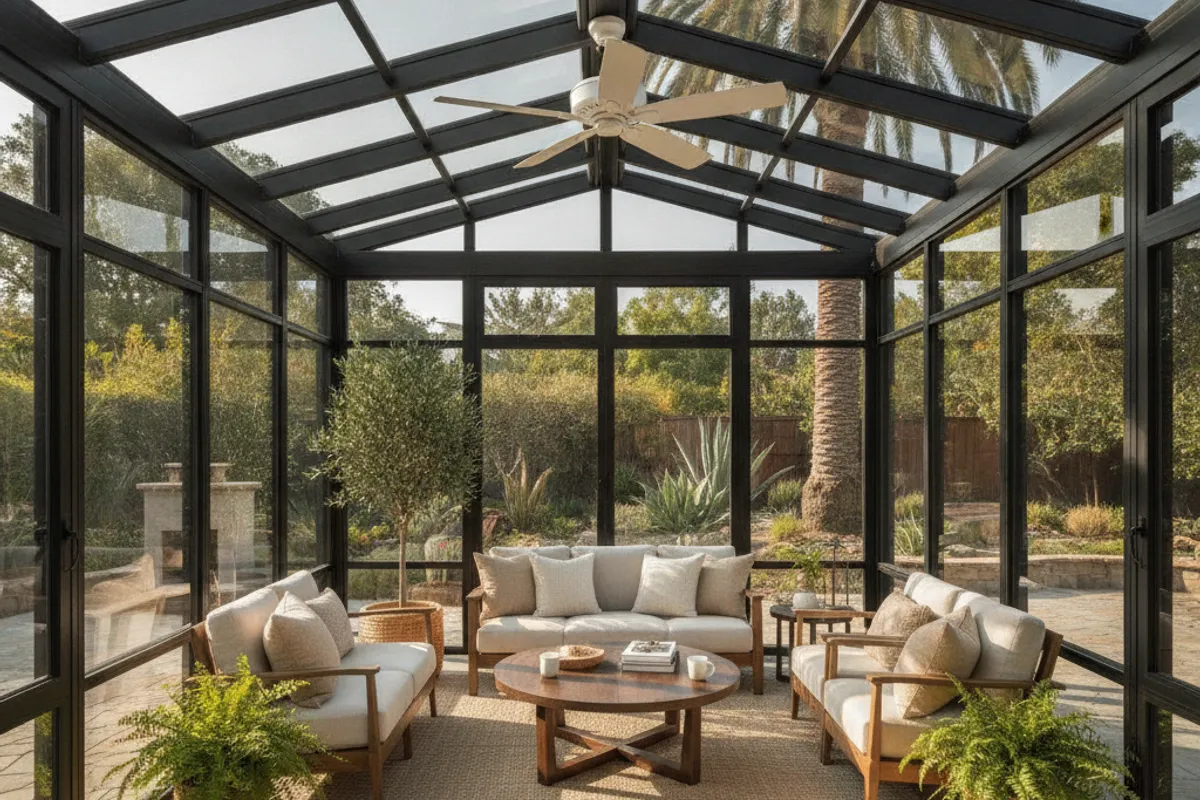
The core difference between the two types
A three-season sunroom is designed for use during the warmer months. It uses single-pane glass or screen panels, has minimal insulation, and is not connected to the home’s heating and cooling system. It is comfortable from roughly March through November in most of San Diego County, which is why the name holds here even though our winters are mild compared to most of the country.
A four-season sunroom is built to be used year-round, in any weather. It uses insulated glass, has an insulated roof, and has its own heat source, which in San Diego is almost always a mini-split heat pump. It is structurally more like a room addition than a patio enclosure.
Why this matters less in San Diego than elsewhere
San Diego’s climate is an outlier. Average winter lows in coastal neighborhoods like La Jolla, Ocean Beach, and Coronado rarely dip below 48F. Even inland areas like El Cajon and Escondido rarely see nighttime temps below 35F. That means a three-season room in San Diego is practically usable 10-11 months a year, not just 7-8 months like it would be in Denver or Chicago.
This makes the cost-benefit calculation different than it would be in a cold-weather market. A San Diego homeowner deciding between the two types is essentially deciding whether they want to use the room on cold winter nights or during the occasional 100F August afternoon, not whether they want to use it in January at all.
When a three-season room makes sense in San Diego
Three-season rooms are the right call for homeowners who:
- Plan to use the room primarily in the morning and evening when temperatures are moderate
- Are building on a budget and want to maximize square footage per dollar
- Are enclosing an existing covered patio on a concrete slab, which limits the structural options anyway
- Live in coastal neighborhoods where the marine layer keeps temperatures from swinging as widely
In Carlsbad, Encinitas, Del Mar, and the Pacific Beach and Ocean Beach areas, a three-season room is comfortable nearly all year with almost no heating. The ocean breeze handles ventilation from April through October.
When a four-season room makes sense in San Diego
Four-season rooms are the better choice for homeowners who:
- Live in the inland valleys or east county, where summer heat can exceed 100F and winter nights occasionally drop to the mid-30s
- Want the room to function as actual living space year-round, not an occasional retreat
- Plan to install a home office, a gym, or a room for a family member who needs climate comfort
- Are building a larger addition where the cost difference per square foot between three- and four-season is smaller
In areas like Ramona, Alpine, El Cajon, Santee, and Lakeside, summer temperatures in a room without climate control can make it unusable from noon to 6 PM. For those locations, a four-season room with a mini-split is the only practical choice if you want regular use.
The cost difference
A three-season room costs materially less than a comparable four-season room. The difference comes from three places: insulated glass vs. single-pane glass, insulated roof panels vs. uninsulated, and the HVAC system.
For a 250-square-foot addition:
- Three-season prefab with aluminum frame and single-pane glass: $18,000-$32,000 installed
- Four-season room with insulated panels, dual-pane low-E glass, and mini-split: $45,000-$70,000 installed
That is a significant difference, and whether it is worth it depends on how you will use the space.
Permit and code implications
Both types require a building permit in San Diego County. A four-season room that is connected to the home’s HVAC system or that is built with insulated walls and a full foundation is more likely to be classified as a permitted addition with full building code compliance, including Title 24 energy requirements. That classification affects not just the permit cost but also the property tax assessment.
A three-season enclosure attached to an existing slab may qualify as a lighter permit class in some jurisdictions, but it still requires a permit. For a deeper look at the permit process, see the sunroom planning consultation page.
The hybrid option
There is a middle ground: a three-season room that is built with dual-pane low-E glass and a small ductless mini-split added later. This approach lets you get more of the year-round usability at a lower upfront cost than a full custom four-season build, while still getting the glass quality that handles San Diego’s western sun exposure. It is not a perfect solution, but it is a practical one for homeowners who want more than a patio enclosure but are not ready for a full addition budget.
To get matched with contractors who build both types across San Diego County, call (858) 925-5546. Sun Room SD connects homeowners with insured local crews, from basic patio enclosures to full four-season additions. Verify any contractor’s license at cslb.ca.gov before work starts.
Can I convert a three-season room to four-season later
Yes, it is possible but rarely as simple as just adding a mini-split. The glass panels may need to be replaced with insulated units, the roof may need insulation, and the electrical panel may need capacity added. Get a conversion quote alongside the original build quote so you know the total path cost before committing to the three-season version.