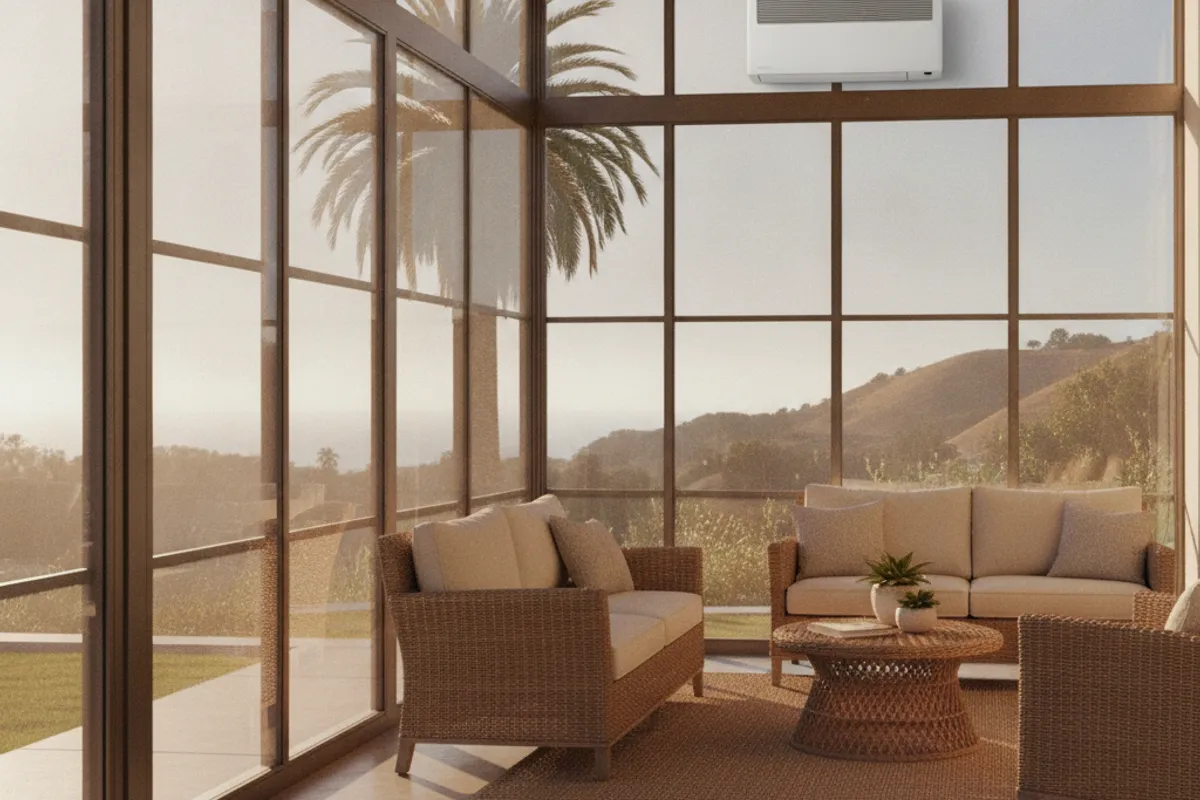
The challenge with sunrooms and temperature
Glass conducts heat much faster than insulated walls. That is the trade-off you make when you choose a glass room over a conventional addition: more light and connection to the outdoors, but more thermal challenge. In San Diego, this plays out differently depending on where you are in the county.
For coastal neighborhoods with mild temperature swings, a well-glazed sunroom may need no mechanical conditioning at all for most of the year. For inland neighborhoods in Santee, El Cajon, Poway, or Ramona, where summer afternoons hit 95-105F, no amount of glass coating fully replaces active cooling.
Understanding what actually works for your specific location and room orientation is the most important part of planning a San Diego sunroom.
The glass comes first
Before talking about mechanical systems, the right glass makes a significant difference in what you need. A west-facing room with standard single-pane glass in El Cajon will get hot. The same room with dual-pane low-E glass rated SHGC 0.20 will be noticeably cooler, and a mini-split will work more efficiently because it has less heat to fight.
The glass selection is the foundation of the thermal strategy. Mechanical systems compensate for what the glass allows in. Get the glass right first. For the full breakdown of what glass specs work in San Diego, see the sunroom glass guide.
The mini-split: the right tool for most sunrooms
A ductless mini-split heat pump is the most practical HVAC solution for the majority of San Diego sunrooms. A mini-split has an outdoor compressor unit and an indoor air handler mounted on the wall or ceiling of the sunroom. It heats and cools without ductwork, which is exactly what you need in a room added to an existing home where running new ductwork through walls and ceilings is impractical.
Why mini-splits work well in San Diego sunrooms:
Efficiency in mild climates. San Diego’s climate is within the operating range where mini-splits perform at high efficiency. They move heat rather than generate it, which means they can produce 2-4x the thermal output per watt of electricity compared to resistance heating.
Precise control. A mini-split conditions only the sunroom, not the rest of the house. You can heat or cool the room independently and turn it off when not in use.
Dual function. The same unit heats in winter and cools in summer, which matters for inland neighborhoods where winter nights occasionally drop below 40F.
Installed cost. A single-zone mini-split system for a 200-300 square foot sunroom runs $2,500-$5,500 installed, depending on the brand, BTU capacity, and complexity of the refrigerant line run from the outdoor unit to the indoor air handler.
Common mini-split brands installed in San Diego sunrooms include Mitsubishi, Daikin, LG, and Fujitsu. These brands have local dealer networks with San Diego service coverage.
The mini-split installation requires a separate mechanical permit and licensed HVAC contractor. The electrical connection to the outdoor unit also requires an electrical permit. Make sure your sunroom contractor coordinates with licensed HVAC and electrical subs, and confirm that both permits are included in the quote.
When you can skip the mini-split
Some San Diego locations and room orientations allow year-round comfort without mechanical conditioning:
North-facing coastal rooms. A room facing north, with coastal fog moderating summer temperatures, in a neighborhood like Ocean Beach, Pacific Beach, La Jolla, or Encinitas, may be comfortable year-round with good glass and natural ventilation. Summer highs in these areas rarely exceed 80F, and a north-facing room avoids the direct afternoon sun entirely.
Small or well-shaded rooms. A 120-150 square foot room that gets shade from a pergola, existing trees, or a deep overhang may stay comfortable without active cooling in coastal and central San Diego locations.
Seasonal use. If you plan to use the room only in spring and fall, or only for morning use before afternoon heat builds, you may not need mechanical conditioning.
The practical test: stand in the planned room location at 3 PM in August and note the temperature and sun angle. If that feels tolerable to you, passive cooling may be sufficient. If it is already uncomfortable in the unbuilt space, it will be more uncomfortable once glass walls are enclosing the heat.
Passive cooling strategies that work in San Diego
Even with a mini-split, passive strategies reduce the cooling load and the operating cost:
Operable windows and vents. Building in operable casement or awning windows, or a roof vent, allows cross-ventilation that can flush heat quickly during the cooler morning and evening hours. In spring and fall, this may be all you need.
Shade on the south and west glass. A fixed or retractable shade system on the south- and west-facing glass surfaces dramatically reduces the solar load before it enters the room. Interior cellular shades or exterior solar shades are both effective. An exterior shade is more effective than an interior one because it blocks the heat before it passes through the glass.
Overhangs. A properly sized roof overhang that blocks the summer sun (which is high in the sky) while admitting the lower winter sun is basic passive solar design. If you are building a custom addition, the overhang design is worth discussing with the contractor.
What about ceiling fans
Ceiling fans do not cool the air, but they improve perceived comfort at the same temperature. A ceiling fan in a sunroom extends the comfort range by a few degrees. For a room that is close to comfortable without air conditioning, a ceiling fan may be sufficient. For a room that needs to drop 15-20F in the afternoon, a fan alone is not adequate.
Proper climate control is especially important in four-season sunrooms that are meant to function year-round, and a mandatory consideration for any glass sunroom with significant south or west-facing exposure.
To get connected with contractors who properly integrate HVAC into their sunroom builds, call (858) 925-5546. Sun Room SD connects homeowners with insured local crews who coordinate mechanical and electrical permits alongside the building permit. Verify any contractor at cslb.ca.gov.
What size mini-split does a sunroom need
A 200-250 square foot sunroom in San Diego typically uses a 9,000-12,000 BTU single-zone mini-split. A larger room or a room with significant west-facing glass exposure in an inland location may need a 15,000-18,000 BTU unit. A proper Manual J load calculation determines the right size. Oversizing causes short-cycling and humidity problems; undersizing leaves the room uncomfortable on peak days.
Can I extend my existing home HVAC into a sunroom
Sometimes, but it requires that your existing system has capacity for the additional load, that ductwork can be routed to the new room, and that the new room is well-enough insulated and sealed to hold conditioned air. For most sunrooms built as additions onto existing homes, a dedicated mini-split is simpler and more efficient than extending the central system.