Why the foundation is the first decision
A sunroom addition is only as good as what it sits on. In San Diego, the foundation decision is more complicated than in many parts of the country because the county has notably variable soil conditions, hillside lots, old concrete patios of uncertain quality, and seismic considerations that affect what the building department will approve.
Getting the foundation right matters for three reasons: structural integrity, permit approval, and long-term performance. A room that shifts, cracks, or settles because the foundation was inadequate costs far more to repair than it would have cost to do it right initially.
The four main foundation options
Using an existing concrete slab
Most San Diego homes built in the 1960s through 2000s have an existing concrete patio slab. If the slab is in good condition, adequately thick (typically 4 inches minimum for a patio, sometimes more for an enclosed room), and has rebar reinforcement, it can often be reused as the sunroom foundation.
Before assuming the existing slab is adequate, the contractor or a structural engineer needs to assess: Is the slab reinforced? What is the thickness? Is it cracked or heaved? Is it properly graded for drainage? What is the soil condition beneath it? Many San Diego patio slabs were poured as decorative surfaces, not structural foundations, and are 2-3 inches thick with no rebar. Those slabs cannot carry a glass enclosure without supplementation.
Reusing a suitable existing slab saves $3,000-$8,000 compared to a new pour and is the most common approach for prefab enclosures on existing covered patios.
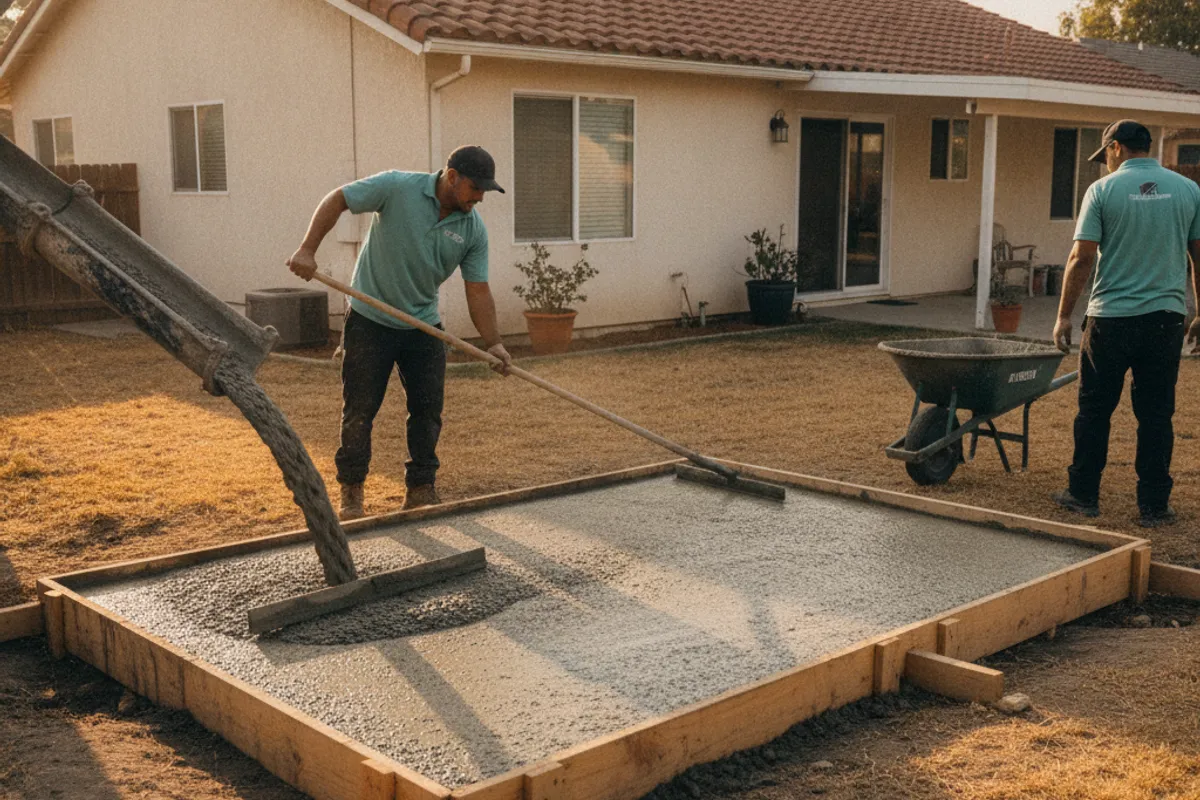
New concrete slab on grade
A new slab is the most common foundation for a sunroom addition built on bare ground or replacing an inadequate existing slab. San Diego’s mild climate means frost protection is not a concern, so a standard slab-on-grade is typically appropriate for most of the county except hillside and expansive-soil areas.
A new slab for a 250-300 square foot sunroom costs approximately $3,500-$7,500 depending on thickness requirements, reinforcement, and site prep. The permit process includes a foundation inspection before the slab is poured and before the structure goes up.
The soil condition under the planned slab matters. San Diego has significant areas of expansive soil, including parts of Chula Vista, National City, the hills of Mission Valley and Tierrasanta, and much of the east county. Expansive soil swells and shrinks with moisture changes and can crack a standard slab. A soils report may be required by the building department for areas with known expansive soil, and the engineer may specify a thicker slab, post-tension design, or modified base preparation.
Post-tension slab
For areas with expansive or unstable soil, a post-tensioned slab uses steel cables tensioned after the concrete cures to resist cracking from soil movement. Post-tensioned slabs are common in new San Diego construction for exactly this reason. They cost more than standard slabs, typically $6,000-$12,000 for a sunroom-sized area, but they are the appropriate solution when the soil report indicates high expansion potential.
Neighborhoods in Chula Vista, Otay Ranch, and parts of Escondido and San Marcos with expansive clay soils frequently require post-tensioned or specially engineered foundations even for residential additions.
Pier and beam or helical piers
For hillside lots, steep grades, or sites where reaching stable bearing capacity requires going below the expansive soil layer, pier-and-grade beam or helical pier foundations are used. The contractor drills or drives piers to stable soil or rock and ties them together with a concrete grade beam on which the room’s framing rests.
This is a more expensive foundation approach, typically $8,000-$20,000+ for a sunroom depending on the number of piers, depth, and site access. It is the right solution for canyon-adjacent lots in neighborhoods like Mission Hills, La Mesa, Lemon Grove, Tierrasanta, and the many hillside communities in north and east San Diego, where a slab-on-grade would shift or crack.
What the permit process requires
San Diego building departments require foundation plans as part of a sunroom addition permit application. For a standard slab-on-grade in stable soil, standard construction details may suffice. For post-tension, pier-and-beam, or hillside situations, the building department will typically require stamped plans from a California-licensed structural engineer.
If the lot is in a hillside or expansive-soil area and the project is significant in size or value, the building department may require a geotechnical (soils) report from a licensed geotechnical engineer before approving the foundation design. This adds cost and time: typically $1,500-$4,000 for the report and 2-4 weeks.
The conversation to have with your contractor
Before any contract is signed, ask the contractor directly: What foundation approach are you proposing and why? Have you assessed the existing slab? Is there a soils concern for this location? Will you need a structural engineer, and if so, is that included in your quote?
A contractor who proposes a foundation without having assessed the existing conditions is writing you a quote that will have change orders.
Foundation scope and cost varies significantly by project type. A sunroom addition on a new slab is a different conversation than a sunroom conversion built on an existing slab.
To connect with contractors who properly evaluate foundation conditions before quoting sunroom projects in San Diego County, call (858) 925-5546. Sun Room SD connects homeowners with insured local crews across the county. Verify any contractor at cslb.ca.gov before signing a contract.
Do I need a soils report for a sunroom in San Diego
Not always. Many standard slab-on-grade sunroom additions in stable-soil areas proceed without a soils report. The building department may require one if the site is in an area of known expansive soil, on a hillside, near a canyon, or if the project scope is large enough to trigger a geotechnical review. Your contractor should know whether your specific address and project scope is likely to trigger this requirement.
Can a sunroom be built on a wood deck
Generally no, at least not a permanent glass-walled sunroom. A permanent addition with glass walls requires a concrete or engineered foundation designed for the structural loads. A basic screen enclosure might be permitted on a properly designed and structurally assessed deck, but this requires engineering review.