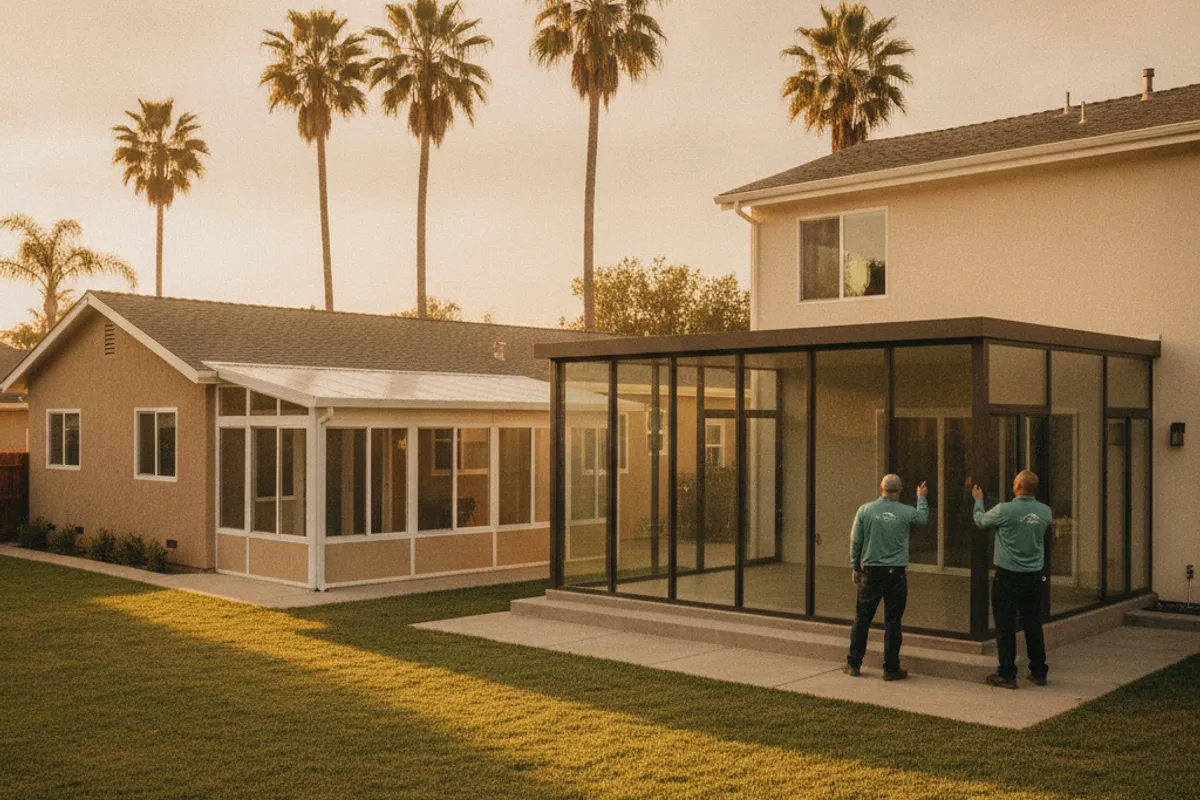
Two ways to add a sunroom
When homeowners in San Diego start shopping for a sunroom, they quickly discover that the market splits into two very different categories: prefab kit systems sold through national manufacturers and local dealers, and custom-built additions framed by a local general contractor. Both produce a glass-enclosed room. The process, price, timeline, and outcome differ significantly.
What prefab means
Prefab sunrooms are engineered systems made by manufacturers like TEMO, Betterliving, Four Seasons, or similar companies. The room comes as a kit with factory-made aluminum framing components, pre-cut glass panels, a roof system, and hardware. A dealer and installation crew assembles the kit on site.
The advantages of prefab:
Speed. A prefab room can often be ordered, permitted, and installed in 6-12 weeks. The manufacturing happens in parallel with the permit review, so by the time the permit is approved, the materials are either on site or en route.
Predictable price. Because everything is manufactured to spec, the material cost is known upfront. Labor for assembly is also relatively predictable since the crews install the same system repeatedly.
Simplified plan review. Many prefab manufacturers provide a standard engineering package that satisfies most San Diego building department requirements. This speeds the permit process compared to custom drawings.
Consistent performance. Factory-manufactured glass units, hardware, and weatherstripping tend to be consistent across the product line. What you see in a dealer’s showroom is what you get.
The limitations of prefab:
Fixed dimensions and proportions. Prefab systems come in module sizes. If your patio is an odd shape or has an obstacle like an HVAC unit, a gas line, or a tree that the modular dimensions do not accommodate cleanly, you may pay more for custom cuts or compromises.
Aluminum framing. Most prefab systems use aluminum framing. It is durable but has a specific look, and aluminum is a better thermal conductor than wood or fiberglass, which affects insulation performance in cold weather. For San Diego, this is less of an issue than it would be in colder climates.
Limited customization. You can usually choose frame color, glass tint or coating, and some panel configurations, but the overall appearance is the appearance of the product line.
What custom means
A custom sunroom is built on site by a general contractor or a specialty addition contractor, using conventional framing techniques: wood or steel stud walls, a stick-framed or engineered roof, windows and glass units sourced separately, and finishes that match or complement the home.
The advantages of custom:
Any size, any shape. A custom build is not limited to module dimensions. If you have an L-shaped patio, a narrow side yard, or a specific ceiling height requirement, a custom build accommodates it.
Integration with the house. A skilled contractor can match the roofline, siding, trim, and interior finishes of the existing home so the addition looks like it was always there. This matters for both aesthetics and resale.
Higher quality glass and materials. A custom build specifies whatever glass units you choose. This means you can specify dual-pane soft-coat low-E glass with a very low SHGC for a west-facing room in Poway or El Cajon, glass that may not be available through prefab product lines.
Potential for higher appraised value. A custom addition that integrates well with the home and uses quality materials is more likely to be appraised as additional living space than a prefab enclosure.
The limitations of custom:
Cost. Custom work costs more because there is more on-site labor, more materials are sourced and cut locally, and the design and permitting process is more involved. A comparable room in custom vs. prefab can cost 40-80% more.
Timeline. Custom additions require structural drawings, engineering review, and a standard plan check cycle. In San Diego, plan check for a room addition runs 4-10 weeks depending on the jurisdiction and its current backlog. Total timeline from permit to finished room: 4-7 months for most custom additions.
Contractor skill variance. The quality of a custom addition depends heavily on the contractor. A poorly built custom room is worse than a well-installed prefab.
How to choose
For most San Diego homeowners with a standard rectangular patio, a mid-range budget, and a desire for a functional outdoor room without a large construction project, a quality prefab system is a practical choice. The major manufacturers make durable products, and the installation timelines are reasonable.
For homeowners who want the room to look like part of the house, who have an unusual space, who want the highest glass quality, or who are building a room intended for year-round use as genuine living space, a custom addition is worth the additional cost and timeline.
Learn more about each path on the prefab sunrooms and sunroom additions pages.
To get connected with contractors who build both prefab and custom sunrooms across San Diego County, call (858) 925-5546. Verify any contractor at cslb.ca.gov before committing to a contract. For details on what a custom addition costs, see the sunroom cost guide for San Diego.
What prefab sunroom brands work well in San Diego
Several manufacturers have dealer networks in San Diego County. Look for a dealer who has completed local installations you can visit, who has a verifiable CSLB license, and who can provide references from customers in your city or neighborhood. The manufacturer brand matters less than the quality of the local installation crew.
Can a prefab sunroom be permitted in San Diego
Yes. Prefab sunrooms require building permits just like custom additions. The advantage is that prefab manufacturers often provide a standard engineering package that satisfies plan review requirements without a custom structural analysis, which can speed the permitting timeline.