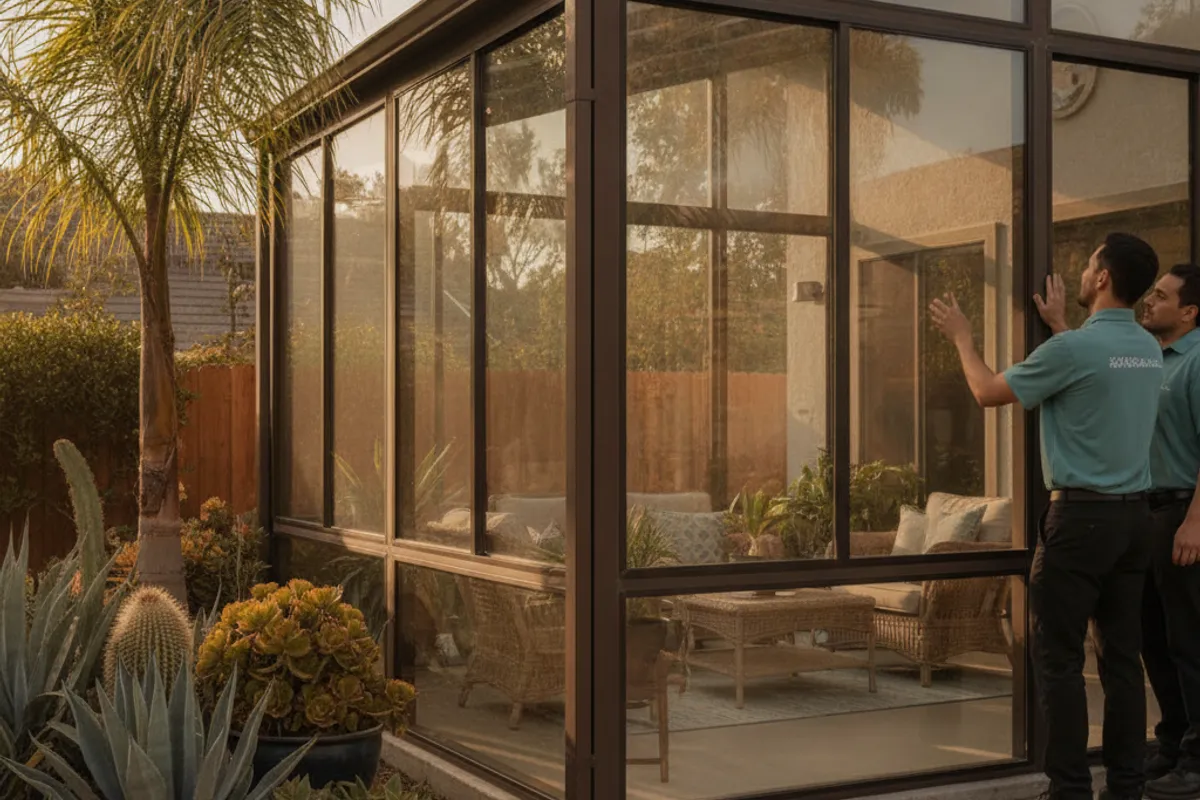
Why glass selection matters more in San Diego than most places
San Diego gets roughly 266 sunny days per year. That is good news for enjoying a sunroom. It also means a west- or south-facing glass enclosure can become unlivably hot from April through October if the wrong glass is used. The coastal areas get some relief from the marine layer, but inland neighborhoods like Santee, El Cajon, Poway, and Escondido regularly see afternoon temperatures above 90F from June through September.
Glass selection is the most consequential decision in a San Diego sunroom build. The wrong choice means using the room only in the morning, or running a mini-split constantly to compensate.
The two numbers that matter: U-factor and SHGC
Every glass unit used in a sunroom carries two ratings on its NFRC label:
U-factor measures how much heat the glass conducts through it. Lower numbers mean better insulation. Ratings range from about 0.20 (very good) to 1.20 (single-pane with no coating). For a four-season San Diego sunroom, aim for U-factor 0.30 or below. For a three-season room, U-factor 0.40-0.50 is acceptable since you are not trying to maintain a constant interior temperature.
SHGC (Solar Heat Gain Coefficient) measures how much solar radiation passes through the glass as heat into the room. Ratings range from 0 (blocks all solar heat) to 1 (admits all solar heat). For San Diego sunrooms with significant east, south, or west exposure, SHGC is the more important number. A room facing west with SHGC 0.40 glass will be noticeably cooler in the afternoon than the same room with SHGC 0.60 glass.
California’s Title 24 energy code sets minimum requirements for SHGC in each climate zone. Coastal San Diego (climate zones 6-7) typically requires SHGC 0.25 or below for west-facing glazing. Inland San Diego (climate zones 9-10) has tighter requirements. Your contractor’s energy compliance documentation will specify what the code requires for your address.
Low-E coatings: what they do
Low-E (low-emissivity) glass has a microscopically thin metallic coating applied to one surface that reflects radiant heat while still admitting visible light. There are two main types:
Hard-coat low-E (also called pyrolytic or Type I): Applied during glass manufacturing. More durable, can be used in single-pane applications. Less effective at blocking solar heat than soft-coat.
Soft-coat low-E (also called sputter-coat or Type II): Applied after manufacturing in a vacuum chamber. More effective at blocking solar radiation. Must be used in the sealed air space between panes in a double-pane unit to protect the coating. This is the type used in modern insulated glass units (IGUs) for sunrooms.
For San Diego sunrooms, soft-coat low-E in a dual-pane IGU is the baseline recommendation for any room with significant sun exposure. The performance difference between low-E and standard clear glass is meaningful: low-E dual-pane can block 40-70% of solar heat gain compared to clear single-pane glass.
Glass options by sunroom type
Screen rooms and basic patio enclosures: Screen mesh with no glass at all. No solar heat gain issue, but no temperature control either. Appropriate only for very mild, coastal San Diego locations where evening mosquitoes are the main concern.
Three-season sunrooms: Typically use single-pane tempered glass with or without a low-E coating. Budget builds use clear single-pane; the performance is poor on sun-exposed sides. A step up to single-pane low-E glass costs 15-25% more and meaningfully reduces afternoon heat in a west-facing room.
Four-season sunrooms and glass rooms: Should use dual-pane insulated units with soft-coat low-E. For east- or north-facing rooms with less direct sun, SHGC 0.35-0.45 is fine. For south- or west-facing rooms, specify SHGC 0.25 or below. The difference in cost between high-SHGC and low-SHGC glass in a dual-pane unit is modest compared to the HVAC savings and comfort improvement.
Overhead glass (glass roof panels or skylights): This is the most critical application. Solar radiation through an overhead surface is much more intense than through vertical glass because the glass is nearly perpendicular to the sun’s path. For any overhead glass in San Diego, specify tempered safety glass (required by code) with a low-SHGC soft-coat low-E coating, and seriously consider an interior shade system as well. SHGC 0.20 or below for overhead glazing in inland areas.
Tinting and solar film
Tinted glass reduces visible light transmission and reduces solar heat gain. Gray or bronze tints are a cost-effective way to lower SHGC, but they also darken the room more than a low-E coating. Solar control film applied to existing glass is an option for homeowners who already have a room with too much heat gain, though film does not achieve the performance of a quality low-E coated IGU.
For more on how the room’s orientation and HVAC design work together, see the heating and cooling guide for San Diego sunrooms.
Glass specification has the biggest impact on glass sunrooms and four-season sunrooms, where maximizing light while managing heat is the core design challenge.
To get connected with contractors who specify the right glass for your specific exposure and location in San Diego County, call (858) 925-5546. Verify any contractor at cslb.ca.gov. The glass spec should be listed explicitly in your written quote.
What SHGC should I specify for a west-facing San Diego sunroom
For a west-facing room anywhere in San Diego County, specify SHGC 0.25 or below in a dual-pane soft-coat low-E unit. In inland areas like El Cajon, Santee, or Escondido, go to SHGC 0.20 or below if available. The afternoon sun load from the west in those areas is intense from May through October.
Does low-E glass block UV as well as heat
Yes. Soft-coat low-E glass blocks a significant portion of ultraviolet radiation in addition to reducing heat gain. This matters for furniture, flooring, and fabrics inside the sunroom, all of which degrade faster under direct UV exposure. The UV protection is a practical benefit of low-E glass beyond the comfort and energy benefits.