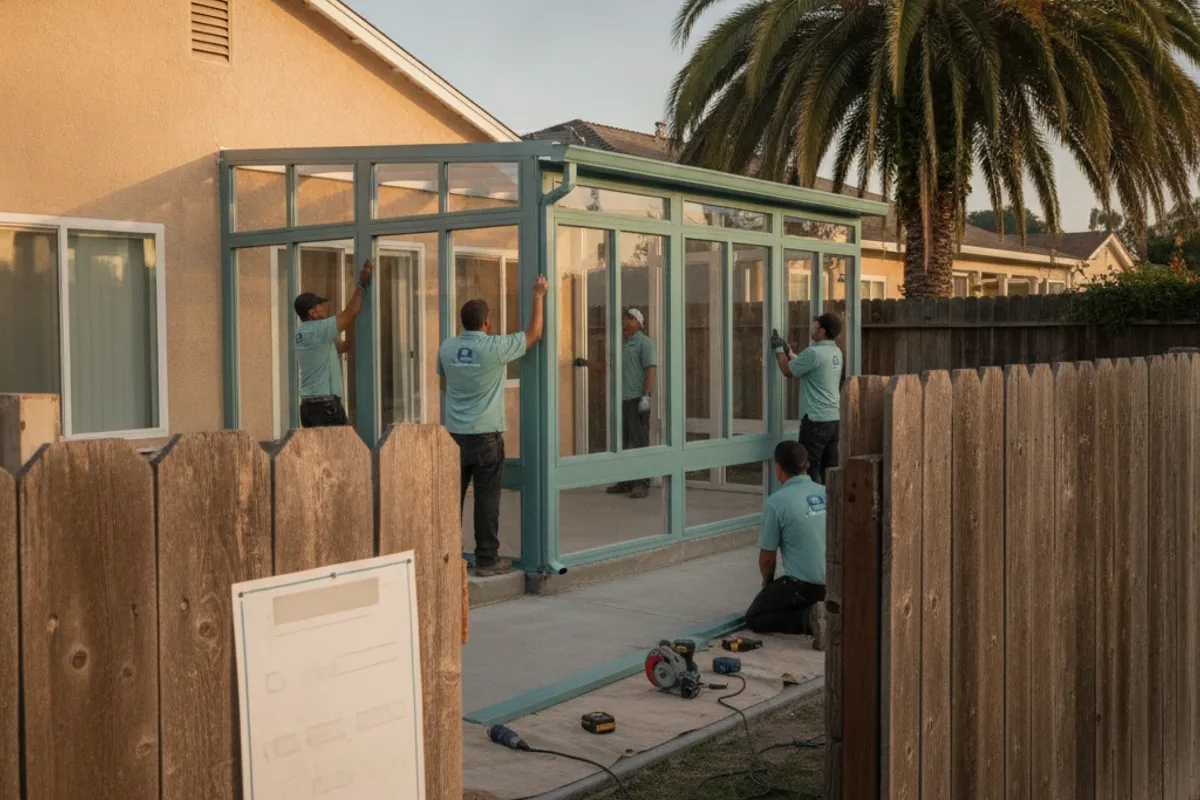
The short answer
Yes. A sunroom addition in San Diego County requires a building permit in virtually every case. This applies to both prefab kit enclosures and custom-built additions, to attached rooms and freestanding structures, and to every incorporated city in the county as well as the unincorporated county area administered by the County of San Diego Department of Planning and Development Services.
The one narrow exception is a freestanding shade structure or patio cover below certain height and area thresholds, but the moment you add walls, glass panels, a roof that sheds weather, or any electrical or mechanical connection, you are in permit territory.
Which jurisdiction handles your permit
San Diego County has 18 incorporated cities, each with its own building department and permit process. Your permit goes to the city your home is in, not to the county.
Common jurisdictions and their building departments:
- City of San Diego: Development Services Department (DSD)
- Chula Vista: Development Services Department
- El Cajon: Building Division
- Escondido: Building Division
- Santee: Development Services
- Carlsbad: Building Division
- Oceanside: Development Services Department
- Unincorporated county areas (parts of Spring Valley, Lakeside, Ramona, Jamul, and others): County of San Diego, Planning and Development Services
If you are not sure whether your address is in an incorporated city or unincorporated county, check the County Assessor’s parcel lookup. Your contractor should also know which jurisdiction applies from your address.
What a permit covers
For a sunroom addition, the permit typically covers:
Structural: The framing, foundation, and connections to the existing house. For a custom addition, the plans must show the foundation type, floor framing, wall framing, and roof framing with member sizes. The inspector verifies that the work matches the approved plans.
Energy compliance: California’s Title 24 energy code applies to any conditioned addition, meaning any space that will be heated or cooled. The glass must meet minimum U-factor and SHGC (solar heat gain coefficient) requirements for the applicable CEC climate zone. San Diego County spans multiple climate zones, with coastal areas generally in zones 6 or 7 and inland areas in zones 9 or 10. Your contractor’s energy compliance documentation will specify which zone applies.
Electrical: Any electrical work inside the sunroom, including outlets, lighting, and connections to a mini-split, requires a separate electrical permit and inspection.
Mechanical: A mini-split or any HVAC work requires a separate mechanical permit.
Egress: If the sunroom is adjacent to a sleeping room or connects to one, egress requirements may come into play. Inspectors check that there is a means of emergency exit.
What the permit process looks like for a sunroom
The general process for a sunroom permit in San Diego:
- Plans prepared: Your contractor or a designer prepares plans showing the foundation, framing, glazing specs, and energy calculations. Prefab manufacturers often provide a standard plan package that speeds this step.
- Application submitted: The contractor submits the permit application to the local jurisdiction, typically online. The city of San Diego and most other jurisdictions in the county accept digital submissions.
- Plan review: Simple prefab enclosures on existing slabs may be reviewed over the counter or within a few days. Custom additions with new foundations typically go through a standard plan check cycle, which runs 3-8 weeks in most San Diego jurisdictions depending on backlog.
- Permit issued: Once plans are approved, the permit is issued, and work can begin.
- Inspections: Most sunroom projects require inspections at the foundation stage, the framing stage, and a final inspection after all work is complete, including any electrical and mechanical work.
- Permit closed: A passed final inspection closes the permit and records the addition on the property’s permit history.
Why unpermitted sunrooms cause problems
San Diego has a notable number of unpermitted patio enclosures and sunroom additions, many done years ago. They create three specific problems:
Disclosure at resale. California law requires sellers to disclose known unpermitted work. An unpermitted sunroom visible in listing photos or on a buyer’s walk-through will surface. Buyers may ask for the room to be permitted retroactively, which requires demolition of finishes for inspection in many cases, or they may discount the purchase price.
Insurance complications. If there is a loss involving the unpermitted structure, the insurer may deny or reduce the claim. Unpermitted work is a known exclusion in many homeowner policies.
Safety. A sunroom built without engineered plans may have structural deficiencies, glass that does not meet safety glazing requirements, or electrical work that is not up to code. The permit process exists in part to catch these.
Retroactive permitting for an existing unpermitted enclosure is possible but usually requires opening walls for inspection and may require corrections. It is almost always more expensive than permitting properly at the start.
The HOA layer
Many San Diego communities also require HOA approval for any exterior addition. The HOA review is separate from the building permit and usually must be completed before permit submission. Common HOA-restricted neighborhoods include Rancho Bernardo, 4S Ranch, Carmel Mountain Ranch, Scripps Ranch, and planned communities in San Marcos, Carlsbad, and Chula Vista. Check your CC&Rs before getting contractor quotes so you know the approval requirements upfront.
For details on navigating HOA approvals alongside building permits, see the HOA rules guide for San Diego sunroom additions.
Permits are required for every structure we work with, from sunroom additions and patio enclosures to prefab sunrooms.
To connect with contractors who pull permits on every project and know which jurisdictions require what, call (858) 925-5546. Verify any contractor at cslb.ca.gov before work begins.
Can a prefab sunroom be installed without a permit
No. A prefab sunroom kit still requires a building permit for the installation. The prefab manufacturer may provide a standard plan package that simplifies plan review, but the permit process itself is not waived. Contractors who offer to “skip the permit” on a sunroom installation are putting you at legal and financial risk.
How long does a sunroom permit take in San Diego
Simple prefab projects on existing slabs can be permitted in 1-3 weeks in many San Diego jurisdictions. Custom additions with new foundations typically take 4-10 weeks from application to permit issuance, depending on the jurisdiction’s current plan check backlog.